

Belotero Filler: Why It Is Used for Under-Eye Lines, Nasolabial Folds and Neck Lines, and How Long It Lasts
A single Belotero gel contains both densely and loosely cross-linked areas. This guide explains why it suits thin skin, where Soft and Intense are each used, and what to expect regarding discomfort and longevity.
The line beside your mouth stays even after you stop smiling, a few horizontal creases show up on your neck in photos, and fine lines have settled in under your eyes. Even if you have been caring for your skin with skin boosters or lifting treatments, it is common for these lines to remain while texture and firmness improve.
When you start looking into fillers, the name Belotero comes up often for the under-eye area and neck lines. At the same time, you may worry that filler placed in thin skin will be visible, or that you will be able to feel it. This article walks through how Belotero differs from other fillers, how Soft and Intense are chosen, what the procedure and recovery feel like, how long results last, and what to check beforehand.
Summary
Belotero is a hyaluronic acid filler made of a soft gel that settles into the tissue as if blending in, so the edges of the gel are less noticeable even where the skin is thin. This is because each gel combines densely and loosely cross-linked areas within a single matrix. Soft is used for fine lines on the surface under the eyes and for neck lines, while Intense is used for nasolabial folds and deeper wrinkles. Results typically last 6 to 18 months depending on the area.
Contents
How is Belotero different from other fillers?
Which lines is it used for? What is the difference between Soft and Intense?
Won't it show through or look uneven in thin skin?
Does it hurt? How long do marks last?
How long does it last, and what happens once it is absorbed?
What to check beforehand and combining with other treatments
Frequently asked questions
1. How is Belotero different from other fillers?
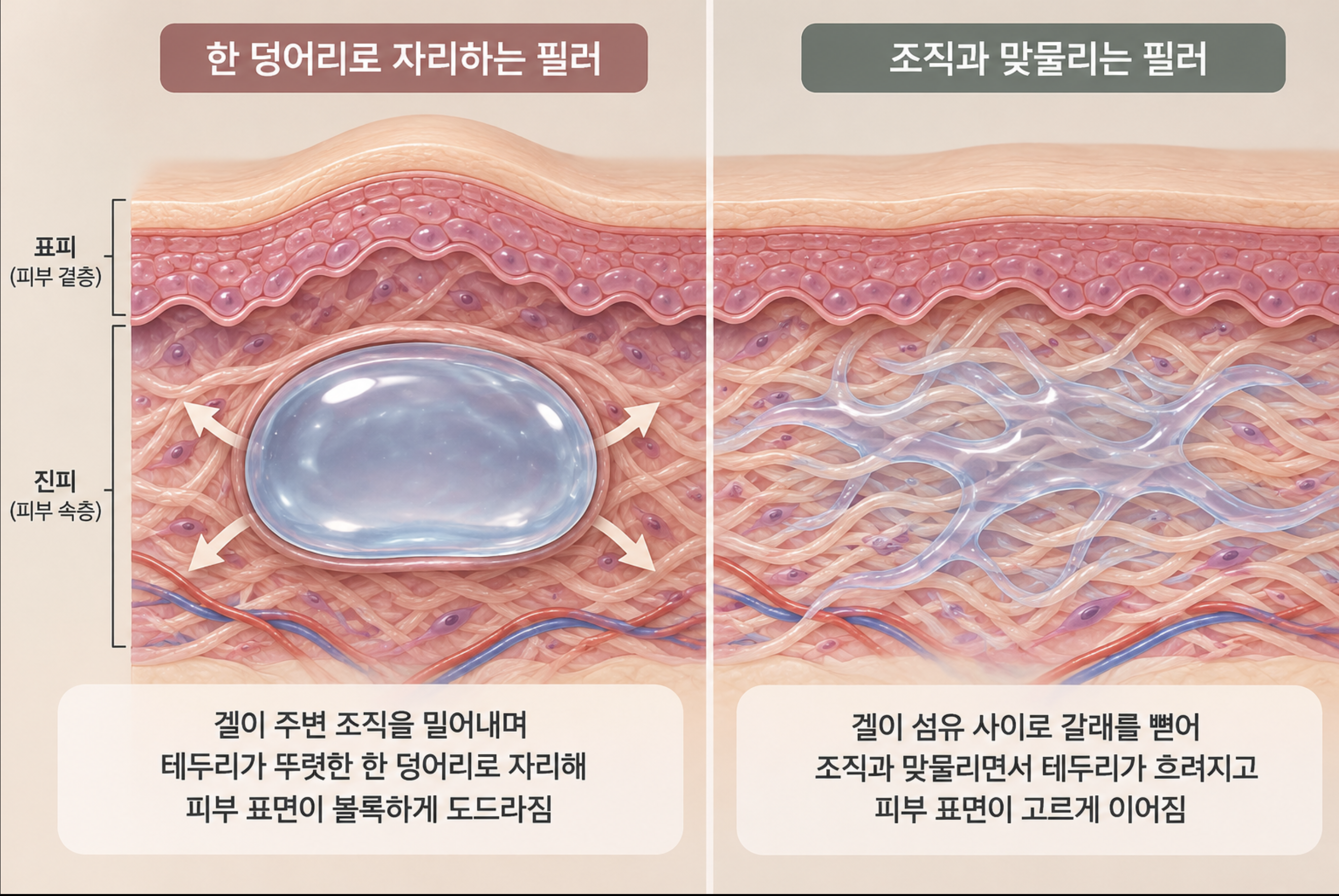
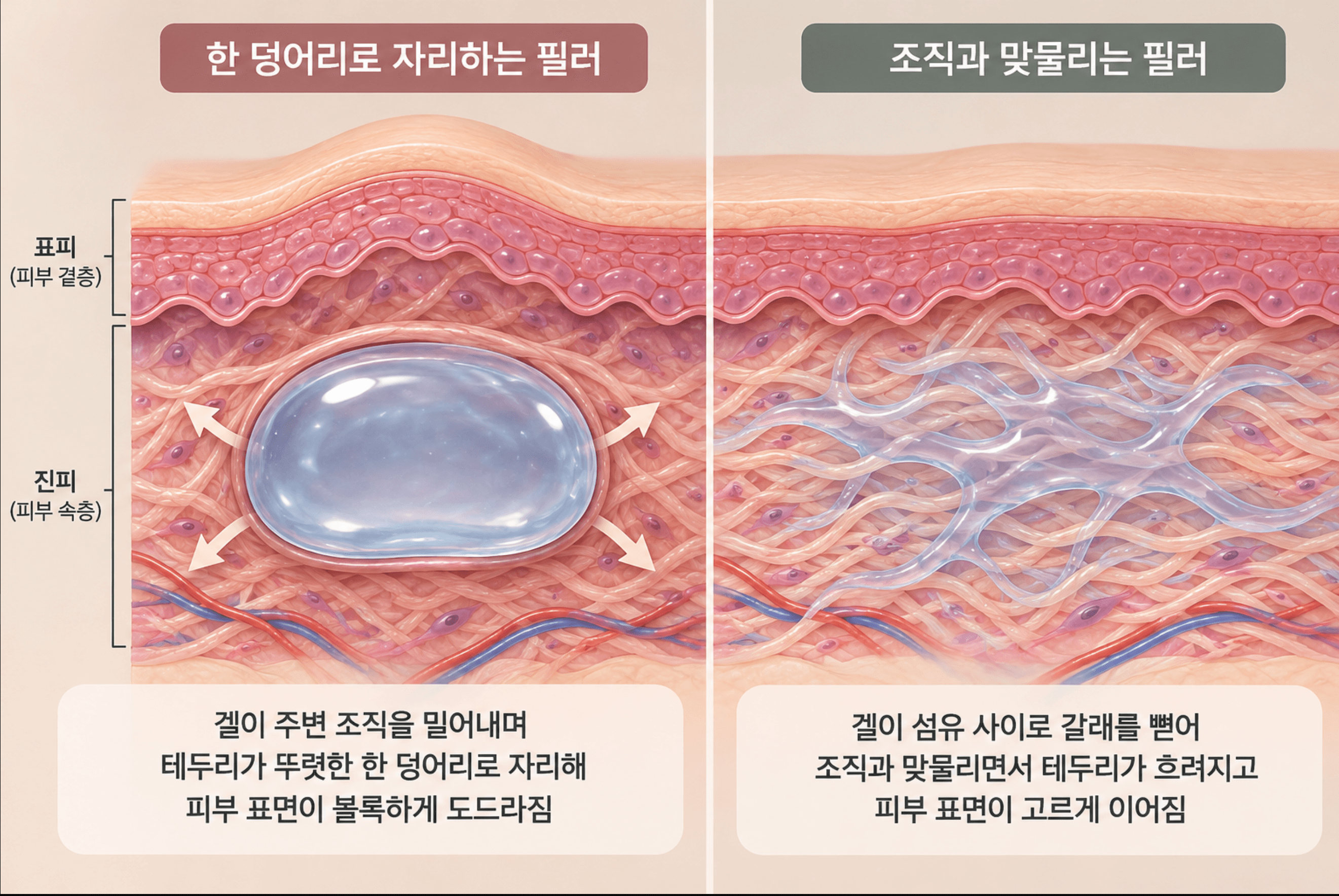
The key difference is that the edges of the injected gel do not separate sharply from the surrounding tissue.
Injected gel makes room for itself between tissues beneath the skin. If it pushes the surrounding tissue aside and settles as a single mass, it leaves a distinct outline, and the thinner the overlying skin, the more that outline shows on the surface. Belotero instead settles by branching into the gaps in the tissue, which blurs its edges. As a result, it is less likely to be felt by touch, and even in thin areas the difference between where the gel is and where it is not is less visible.
The difference comes from how the gel is cross-linked
Hyaluronic acid is a substance naturally found in the skin, but on its own it flows like water. To keep it from flowing, its chains are bound to one another and set into a gel. Brands differ in how they do this binding, which is covered in more detail in our article on types of fillers and how they differ.
Rather than cross-linking the whole gel uniformly, Belotero combines densely and loosely cross-linked areas within one gel. Academic analysis of this approach, known as Cohesive Polydensified Matrix (CPM) technology, describes it as producing a gel with varying densities: the denser portions last longer and hold their shape under pressure, while the looser portions make injection easier and allow the result to be molded by gentle pressure after injection (1). In other words, the denser parts hold the shape, while the looser parts integrate into the gaps in the tissue and leave room to refine the contour right after the procedure.
If it blends in, won't it spread out or migrate?
Spreading here means settling along the gaps in the tissue, not dispersing, and the denser portions hold the gel together. Research on the same technology likewise notes that the gel passes easily through the needle yet does not migrate once it has settled (2). The looser portions do not disappear first either; the gel as a whole is gradually absorbed.
You may also have seen the same brand name on lists of skin boosters. Fillers restore lost volume and fill creases, whereas Belotero Revive (a skin booster) addresses hydration and texture within the skin, so the two serve different purposes.
2. Which lines is it used for? What is the difference between Soft and Intense?
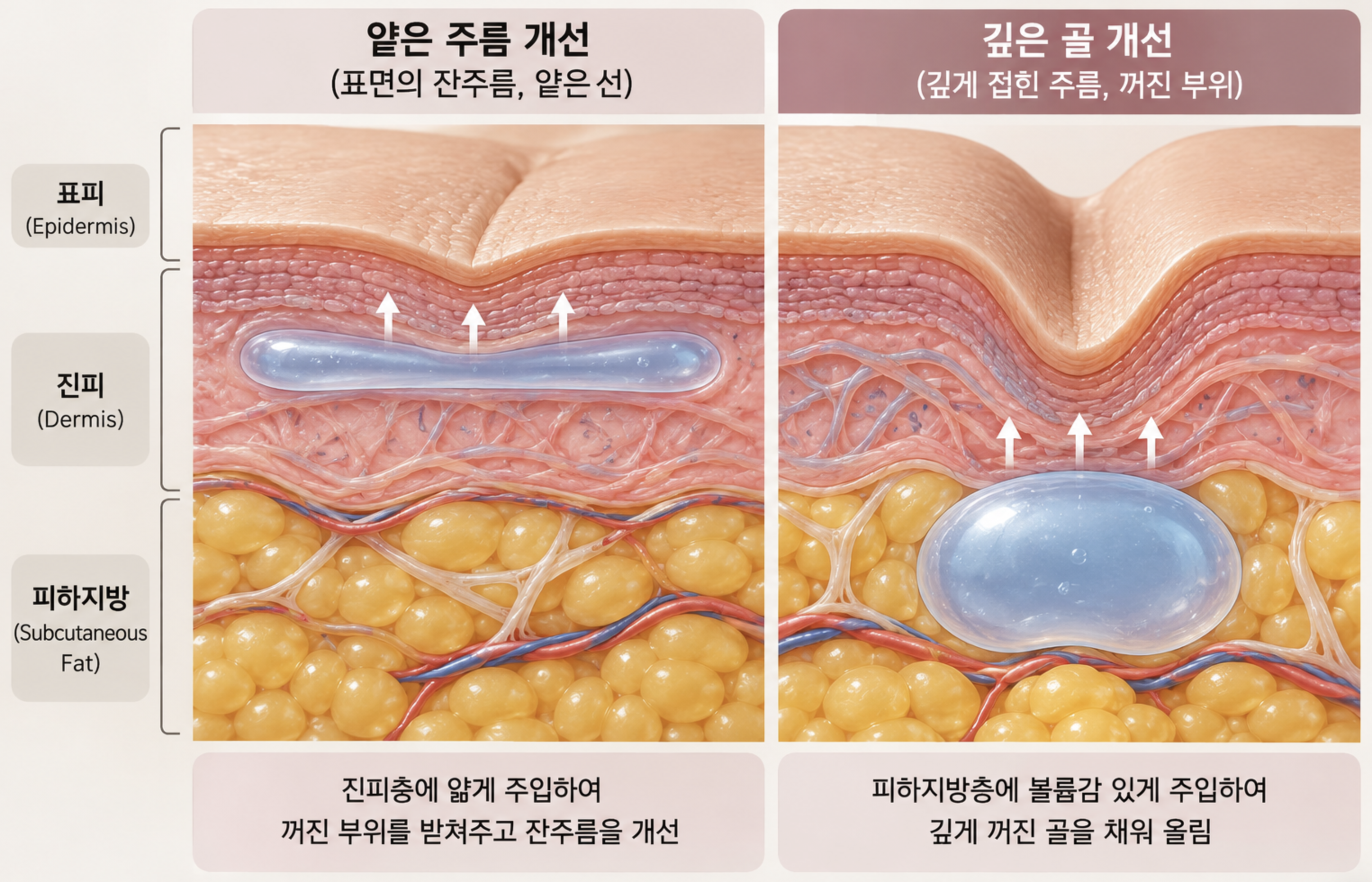
It is used for both fine, shallow lines and deep folds, and the choice depends on how thin the overlying skin is and how often the area folds.
Soft: areas where thin skin makes gel easy to see
This includes fine lines around the eyes and mouth, horizontal neck lines, and fine lines on the surface under the eyes. The gel is spread thinly into the dermis, the inner layer of the skin. The manufacturer also notes that this product blends smoothly with the skin when used for fine lines around the mouth (3).
Intense: areas that fold often and form creases
It is used where firm support is needed, such as nasolabial folds and deep wrinkles. An international expert consensus paper also notes that gels of this type have a cohesive quality that helps them withstand the repeated forces of facial movement, making them suitable for lifting and contouring (4).
Even under the eyes, the depth depends on what is being corrected
A hollow tear trough that casts a shadow is caused by volume loss, so the overlying tissue is supported from the deepest layer, closest to the bone. Fine lines on the surface are treated by spreading gel in a much shallower layer. Soft is used in both cases, with only the injection depth changing. Because the skin under the eyes is the thinnest on the face, preventing the gel from showing through comes first, so the ability to integrate into the tissue matters more than firmness.
Shallow lines and deep folds also call for different roles from the gel. A deep fold is lifted from below to soften it, while a shallow line is supported thinly from just beneath to smooth it out. That said, the choice is not determined by the name of the area alone. Even for the same under-eye area or nasolabial fold, depth of the crease and skin thickness vary from person to person, so the decision is made together during the consultation.
3. Won't it show through or look uneven in thin skin?
It tends to be less noticeable. Outlines become visible when the gel sits sharply separated from the tissue.
When gel settles as a single mass in a shallow layer, the surface can bulge, and the thinner the skin, the more light can scatter off the gel and create a bluish tint (the Tyndall effect). This is why Belotero is used in shallow areas. Because it integrates into the tissue and its edges blur, it is less likely to show through or form lumps even when placed superficially. The consensus paper mentioned above likewise notes that soft gels that blend seamlessly with the skin are suited to shallow layers, where unevenness and visible gel must be avoided (4).
However, the product's properties alone do not determine the outcome. If more than the necessary amount is injected, or if it is placed at the wrong depth, any gel can leave visible traces. That is why we inject in small amounts and check the balance between both sides as we go.
4. Does it hurt? How long do marks last?
There are two kinds of sensation
With Intense, which is placed deeper, you feel a sting as the needle first enters, followed by a sensation of firm pressure as the gel is pushed in. Soft, placed thinly in a shallow layer, feels different: rather than pressure, there is a sharp, prickling sensation on the surface of the skin, similar to receiving a skin booster. Knowing this in advance makes the procedure less surprising, so we explain both sensations beforehand.
How discomfort is managed
We apply numbing cream and allow 20 to 30 minutes for it to absorb before starting, and add local anesthesia for patients who are sensitive to pain or for areas injected more deeply. In addition, both Soft and Intense contain an anesthetic (lidocaine), so any stinging tends to subside quickly once the product is in. Including numbing and design time, the total visit takes about one hour.
Recovery
Swelling usually settles within 3 to 7 days, and any bruising fades over 1 to 2 weeks. You can wash your face and apply light makeup 3 to 4 hours after the procedure, once the needle marks have closed. For the same 1 to 2 weeks, it is best to avoid saunas, strenuous exercise, and pressing firmly on the treated area, as heat and pressure can disturb the shape while the gel is settling into the tissue.
5. How long does it last, and what happens once it is absorbed?
Product | Main areas | Average duration |
|---|---|---|
Intense | Areas needing volume, such as nasolabial folds | About 12–18 months |
Soft | Fine, shallow lines such as neck lines and the under-eye surface | About 6–12 months |
These are averages and may vary depending on the amount injected and each person's rate of breakdown.
The body naturally contains enzymes that break down hyaluronic acid, so injected gel is gradually broken down and absorbed over time. This is where the densely cross-linked portions come into play again: the more tightly the chains are bound, the harder it is for enzymes to reach the interior, so those portions hold their shape for longer.
The gel does not suddenly deflate one day; it thins gradually over several months, so a top-up only needs to replace what has been lost. Many people ask whether the area will sag more than before once the filler is fully absorbed. Since the gel occupies a space equal to its own volume and then shrinks by that amount, the area essentially returns to how it was before treatment.
If the result feels insufficient after the first session, a top-up is done 2 to 4 weeks later. Only once residual swelling has gone down and the gel has settled can we accurately judge how much more is needed. This is different from refilling several months later.
6. What to check beforehand and combining with other treatments
Please let us know about the following so we can plan timing and approach together
Use of blood-thinning medication such as aspirin or anticoagulants (may increase bruising)
Any adverse reaction to dental anesthesia (the gel contains an anesthetic)
A tendency to form keloids
Pregnancy or breastfeeding
Wounds or inflammation in the treatment area (treatment is postponed until healed)
When combining with other treatments, the order matters before the interval
If combined with radiofrequency or ultrasound lifting, the skin is tightened first and filler is injected on the same day. If you have already had filler, wait at least one month before radiofrequency and one to two months before ultrasound. Heat applied before the gel has settled can cause it to be absorbed sooner than expected or change its shape.
Botox and skin boosters follow the opposite order. If done on the same day, the shape is set with filler first and the other treatment follows. If done on separate days, allow 1 to 2 weeks between them. If the nasolabial area also has expression lines that only appear when smiling, both are assessed together.
What to inject and how much is decided before the procedure. We confirm which product goes where and in how many stages before starting, so the plan does not expand during the procedure.
Because this treatment involves checking progress after swelling subsides and topping up as needed, it helps to choose a clinic that is easy to return to. NAYA CLINIC is a 3-minute walk from Exit 7 of Sinnonhyeon Station and a 5-minute walk from Exit 10 of Gangnam Station in Seoul.
Choosing Belotero does not start with memorizing product names. Once it is clear how thin the overlying skin is and how often the area folds, the properties the gel needs naturally come into focus.
7. Frequently asked questions
Q. Can filler be used for neck lines?
Yes. Neck skin is thinner than facial skin and folds horizontally every time you lower your head, so it needs a gel that spreads thinly in a shallow layer and interlocks with the tissue rather than one that settles as a single mass. Because it is less likely to clump even with constant movement, Soft is often chosen. The amount depends on the depth and condition of the lines and is decided during the consultation.
Q. Will I be able to feel something under the skin?
Generally less so. When the gel interlocks with the gaps in the tissue, it is less palpable than when it settles as a single mass. However, any gel can be felt if too much is used, so we inject in small amounts.
Q. Will it look unnatural when I smile or talk?
The nasolabial area folds frequently with expression, so it needs a gel that withstands movement while moving with it. Filling too much at once can make that area look stiff, so we inject in stages and ask you to make expressions as we check the result.
Q. Will very deep nasolabial folds disappear in one session?
Rather than flattening them completely in one session, we aim to soften them. Trying to fill them entirely can make the area look out of harmony with its surroundings and, in turn, unnatural.
Q. My lines are shallow. Wouldn't another treatment be better than filler?
They serve different purposes. Clearly defined lines are best addressed by filling and supporting them from beneath, while skin that feels dull and hollow overall is better suited to treatments that replenish the skin from within.
This content is provided for medical information purposes. Effects and side effects may vary depending on individual conditions. Please consult a medical professional for an accurate diagnosis and to decide whether treatment is appropriate.
Some images in this article were generated with AI to aid understanding and may differ from actual treatment results.
References
(1) Vandeputte, J Clin Aesthet Dermatol, 2018
(2) Micheels et al., J Clin Aesthet Dermatol, 2015
(3) Merz, BELOTERO official product information
(4) van Loghem et al., Clin Cosmet Investig Dermatol, 2021

Anti-Aging Center Director