Picotoning vs. Laser Toning: Differences and How to Choose
Picotoning and laser toning are the two most widely used treatments for pigmentation. If you've wondered "they're both toning, so what's the difference?" or "picotoning costs more, so is it more effective?" — this content will walk you through the differences between the two treatments and how to choose based on your situation.
Here's a three-point summary. Both treatments work by using a laser to break down pigment, but they differ in how short the pulses of light are. Laser toning tends to be more effective for larger pigment, while picotoning tends to be more effective for smaller pigment. In some cases, a combined approach is used — starting with laser toning to reduce the size, then finishing with picotoning.
Table of Contents
How Do Picotoning and Laser Toning Differ?
Selection Guide by Pigment Type
Picotoning and Laser Toning Pricing
Frequently Asked Questions
1. How Do Picotoning and Laser Toning Differ?
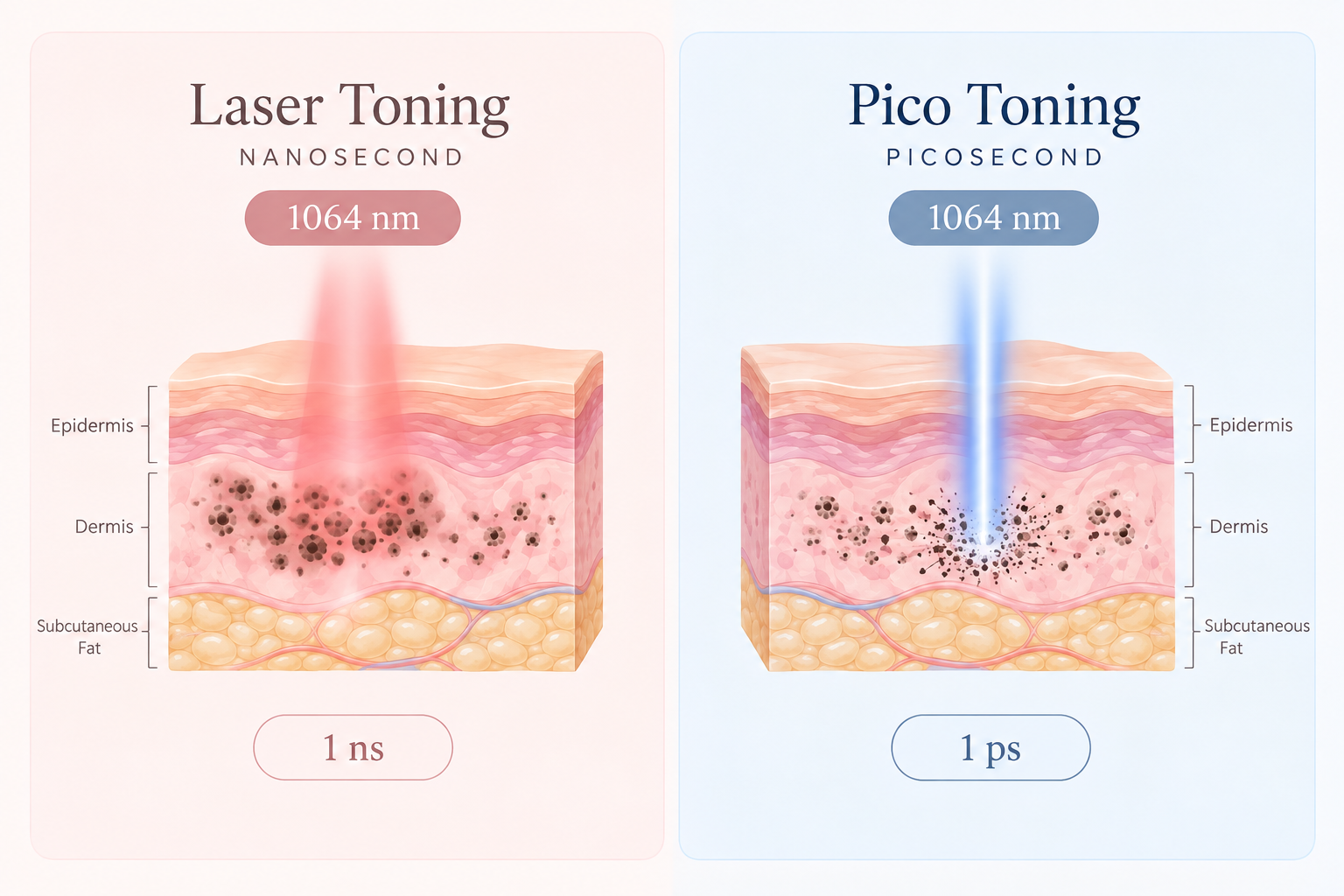
→ Visual comparing the effects of laser toning and picotoning
Both treatments work on the same principle — using a laser to break down melanin pigment beneath the skin — but picotoning delivers light in picosecond (one-trillionth of a second) pulses, while laser toning delivers it in nanosecond (one-billionth of a second) pulses. This means picotoning fires roughly 1,000 times faster, which leads to the following differences.
Difference in how pigment is broken down
Laser toning delivers more energy per pulse, making it more effective at breaking down larger clusters of pigment. Picotoning, by contrast, is better suited to finely breaking down smaller pigment particles.
Difference in heat transfer
Because laser toning uses longer pulses, it transfers relatively more heat to the surrounding pigment area. Picotoning transfers comparatively less heat. Since greater heat transfer increases the risk of post-inflammatory hyperpigmentation, picotoning can be considered relatively safer for repeated treatments.
Treatment outcomes and the likelihood of side effects can vary significantly depending on individual skin condition and the intensity or number of sessions.
2. Selection Guide by Pigment Type
Choosing between the two treatments isn't an either-or decision — the key is selecting or combining them appropriately based on the situation.
Freckles and age spots
These are typically located in the shallow layers of the skin and are small in size. In this case, the difference in effectiveness between laser toning and picotoning is known to be minimal. Since fewer sessions are typically needed, choosing laser toning doesn't carry significant concern about heat damage.
Melasma
Melasma tends to appear in both shallow and deep layers of the skin and is larger in size. Treatment often begins with laser toning to break down larger clusters, switching to picotoning once effectiveness plateaus, or a dual-toning approach combining both from the start may be used. Depending on the case, picotoning alone is sometimes used.
Nevus of Ota / ABNOM (acquired bilateral nevus of Ota-like macules)
These are typically located deep in the skin and are small in size, so starting directly with picotoning is known to be more efficient.¹
The above serves as a general guideline; recommended treatment may vary depending on the depth, area, and skin condition even for the same pigment type. Please consult a medical professional to determine the actual treatment approach.
¹ Reference: Ungaksornpairote C et al., 2020, A Prospective, Split-Face, Randomized Study Comparing Picosecond to Q-Switched Nd:YAG Laser for Treatment of Epidermal and Dermal Pigmented Lesions in Asians (Dermatol Surg)
3. Picotoning and Laser Toning Pricing
Category | Promotional Price |
|---|---|
Facial Picotoning (soothing pack included) | 49,000 KRW |
Face + Neck Picotoning (soothing pack included) | 79,000 KRW |
Body Picotoning (area of two palms) | 69,000 KRW |
As of September 16, 2026
4. Frequently Asked Questions
Q. Which is more painful — laser toning or picotoning?
Picotoning is generally less painful than laser toning. Because picotoning delivers light in shorter pulses, it causes relatively less heat and irritation to the skin. A clinical study also observed lower pain scores for picotoning when comparing pain at the same wavelength.² That said, toning treatments in general aren't very painful, so there's no need for major concern about pain even if you choose laser toning.
² Reference: Feng J & Huang L, 2023, Comparison of Picosecond and Nanosecond Nd:YAG 1064-nm Lasers in the Treatment of Melasma: A Split-Face Randomized Clinical Trial (Plast Reconstr Surg)
Q. Which treatment is better for tattoo removal?
Tattoos are difficult to remove completely with toning alone. Toning is suited to removing pigment such as melasma, freckles, and age spots, whereas removing ink requires a laser at higher output. A representative treatment is high-output mode procedures (such as Zoom, Boost, and Spot modes) using picosecond laser devices.
This content is general informational material about picotoning and laser toning treatments, and is not sponsored or paid content on behalf of any specific medical institution or device manufacturer. It is not intended to diagnose individual conditions or directly recommend a specific procedure. Please consult a qualified medical professional to determine whether treatment is appropriate and which approach to take.

Anti-Aging Center Director